


811 Emergency: The Good, The Bad, The Ugly


Summary
Its rare that an industry study attracts national attention of regulators, legislators, asset owners/operators, engineers, contractors, and others, and perhaps more rare that it opens the door to industry transformation. The 811 Emergency study, published by the Infrastructure Protection Coalition (IPC – www.ipcweb.org) does just that. At least half of the $61 billion in national waste made visible by the study can be recovered to benefit the public with reduced damages to underground utility lines and the related societal impact followed by benefiting rate payers through reduced utility rates. The core question is how to capture this benefit? An answer? Through the consistent application and use of best practices like Subsurface Utility Engineering (SUE).
Study Overview
Failures in the nation’s 811 system used to prevent damage to underground utility lines are costing $61 billion a year in waste and excess costs and creating unnecessary hazards for public safety, particularly in states where the implementation and accountability are most lax (Exhibit 1 - State Quartile Ranking of 811 System Performance). The underlying research hypothesis focused on a belief that “unmarked and mismarked facilities yield lost field production potential and generate excess and unnecessary costs to projects or customers…these costs, born by the utility, utility locator, and underground contractor far exceed the potential and actual fines faced by the asset owners.” The study made visible 4 type of waste, inefficiency, and excess cost that is imbedded in the system and largely invisible. These include: 1) Unnecessary Locates - utilities and third-party locators needlessly sent out to locate lines for construction projects that then do not happen; 2) Poor Instruction - instructions given to locators, causing wasted time or additional work; 3) Destroyed Marks - locate marks destroyed during construction and then needing to be reinstalled; and 4) Wait Time - contractor wait time when location efforts exceed the legal notice period.

Much of the public and industry discussion about the study since it was published in November 2021 has focused on the 4th Quartile states and a root cause analysis of what they might do differently to improve performance, not on what 1st Quartile state are doing to achieve superior performance.
The Good, The Bad, The Ugly
The Infrastructure Protection Coalition (IPC) study was designed to make visible the amount and nature of the waste imbedded in the system, and it was anticipated that additional analysis on root cause and state specific conditions would occur as a next and future step. This type of root cause analysis may make visible the sources and underlying causes of the waste and wait time observed for 4th Quartile states. There has been little public and industry discussion about the 1st Quartile states and what led to their superior performance. This same type of root cause analysis is appropriate to identify the sources and underlying drivers of superior performance. One potential answer…successful application and use of best practices like Subsurface Utility Engineering (SUE).
The 811 Emergency National Report (www.ipcweb.org/images/reports/US-RPT.pdf) highlights 13 recommendations, and anticipates they will eliminate approximately half of the $61 billion in waste costs over a 3-5 year timeline (See Exhibit 2. National Utility Locate System Cost Impacts). Within these recommendations, best practices like SUE are not specifically called out or identified. However, four of these recommendations, in combination, are specifically designed to create space for and support the implementation of SUE: They include:
Mandatory Damage Reporting: Refine the dig law to require reporting of all damages to all underground utility types to support effective data collection, process improvement, damage adjudication & enforcement.
Standardize Minimum Notification Time: Standardize the ticket notification time to a minimum of two full business days after the day/date of a call.
Excavation Site Accurate Description:
Premark / White-line Requirement: Require pre-mark or white-lining of any proposed excavation area that includes traditional reference to intersecting streets/roadways paired with one or more of the following options: GPS coordinates, electronic white-line using aerial image(s), or physical white-lining.
GIS System Adoption by Asset Owners: By 2030, cause all asset owners to adopt a GIS system for asset mapping and require notification through 811 using GPS coordinates.
Standardize Ticket Size - Distance, Duration, and Life: Standardize the ticket size, distance, duration, and life to the described characteristics.

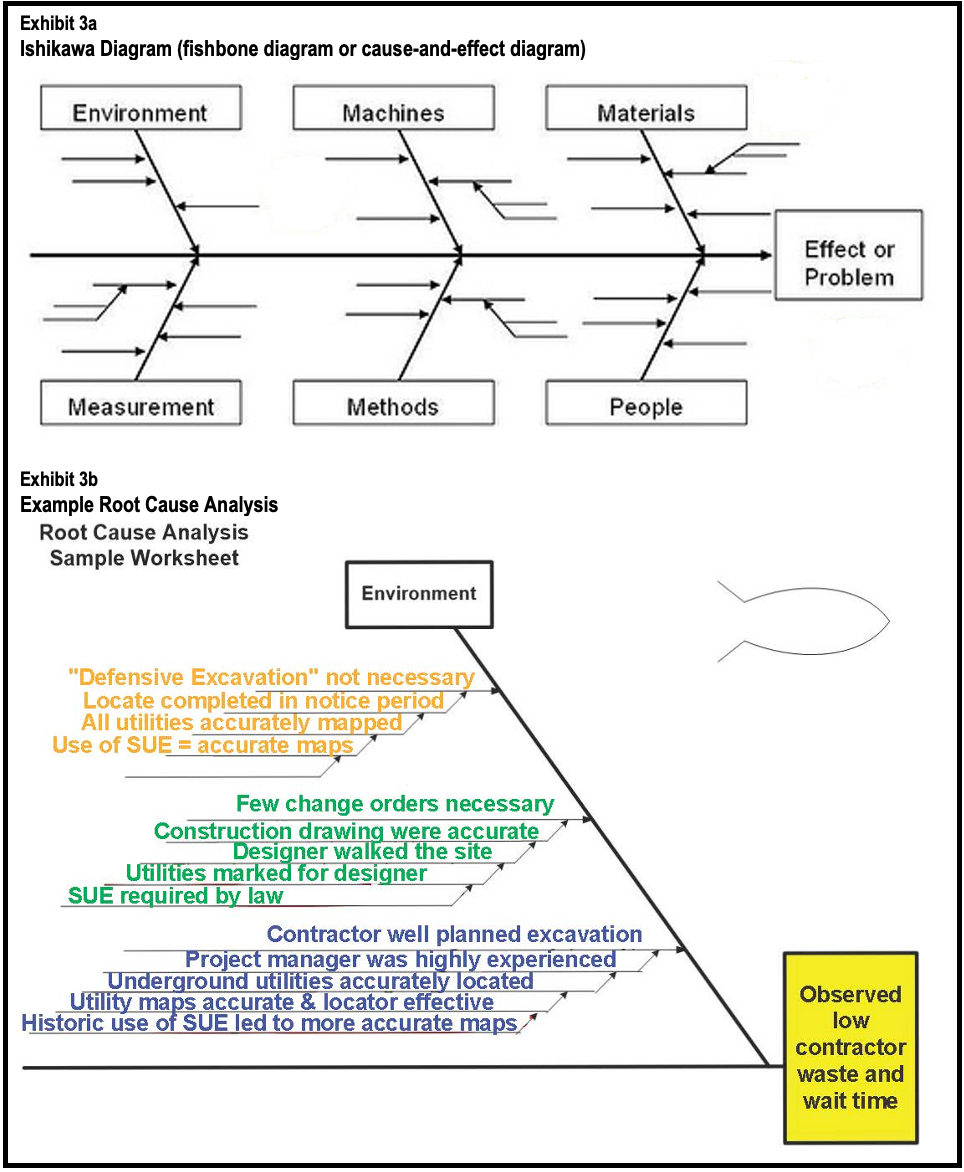
The next step is to apply a structured root cause analysis technique, like “Ishikawa” as a method to uncover the sources and underlying causes of the waste and wait time observed (See Exhibit 3a – Ishikawa Diagram). Interestingly, at least two of the 1st Quartile states, Colorado and Pennsylvania already have a requirement for the application and use of SUE. Using the root cause analysis techniques may serve as one way of confirming a connection between the observation of reduced waste and wait time in specific states with the application and use of a practice like SUE. While the study did not specifically investigate state specific root causes, the IPC views the study as a starting point for further investigation to build a more detailed understanding in a specific state from which action might take place among interested stakeholders at some point in the future. One example of how this state specific root cause analysis might be applied is described in Exhibit 3b - Example Root Cause Analysis.
Next Steps & Conclusions
Much of the public and industry discussion about the 811 Emergency study has focused on the 4th Quartile states without as much attention on the 1st Quartile states and what led to their superior performance. The IPC views the study as a starting point for further state specific investigation to build a more detailed understanding of both superior and inferior performance. The application and use of best practices like SUE are potentially an of the causes of superior performance.
Interested state specific stakeholders are encourage to build from the information made visible through the 811 Emergency study and conduct the appropriate state specific root cause analysis on the 4 types of waste and draw their own conclusions on the causes of the waste and wait time observed as well as the sources and underlying drivers of superior performance. This type of robust follow up analysis may shed light on one answer…successful application and use of best practices like Subsurface Utility Engineering (SUE).
Mark Bridgers is a consultant with Continuum Capital, which provides management consulting, training, and investment banking services to the worldwide energy, utility and infrastructure construction industry. They can be reached at (919) 345-0403 or MBridgers@ContinuumCapital.net and followed on Twitter at @MarkBridgers. For more information on Continuum, visit www.ContinuumCapital.net.
The Infrastructure Protection Coalition is a collaboration from industry groups who represent regular users and stakeholders in the 811 system and want to see it run safely and efficiently. Members include the American Pipeline Contractors Association (APCA), Distribution Contractors Association (DCA), National Utility Contractors Association (NUCA), Nulca – representing utility locating professionals, and Power & Communications Contractors Association (PCCA). For more information on IPC, visit www.ipcweb.org.


Comments